My child needs treatment for a craniofacial deformity: What now?
Parenting is a mix of joy, hope and worry … plus plenty of lost sleep, of course. For the parents of children with concerns about their child’s head shape or a potential craniofacial deformity, late-night worries can feel overwhelming. Can their child’s craniofacial deformity be treated? How will it affect the life of the child moving forward? How complicated is evaluation and treatment going to be?
Pediatric neurosurgeon Lacey Carter, MD, has seen that fear in the eyes of parents firsthand. However, she assures parents they don’t need to worry, as their child’s care team will come together to help them through every step of the process.
What happens first when dealing with potential craniofacial deformity?
“Before surgery is ever discussed, we evaluate the child and talk over potential treatment options with family,” said Dr. Carter. “We decide together on the best course of action.”
In most cases, children are referred to the pediatric neurosurgery team for screening. The team will decide on what treatment options are needed. If surgery is the best option, the team will move forward to schedule a date and time for the surgery.
“During screening, we do look for specific patterns and shapes that help us to know what we’re looking at,” said Dr. Carter. “In some cases, positional changes alone can help, or specialized helmets. In others, the surgical team may discuss the possibility of craniosynostosis, a condition where the bones and plates of a child’s head start to fuse together too early. This can restrict skull growth and cause abnormal head shape or even issues with brain development.”
Craniosynostosis doesn’t respond to helmet therapy alone, so surgical treatment is usually the best option. The care team considers the child’s age, head shape and type of craniosynostosis when deciding on surgery. Dr. Carter works closely with plastic surgeon Dr. David Lobb to minimize visual scarring or other lasting effects.
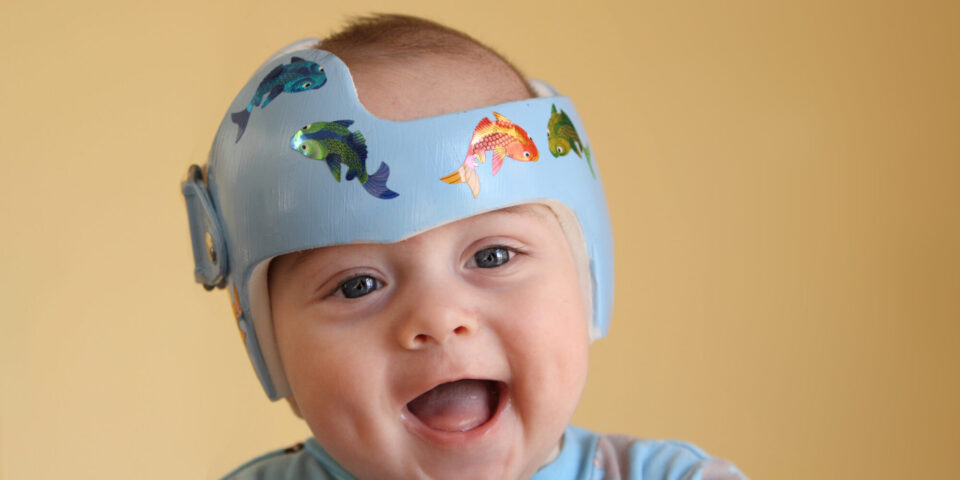
“Plagiocephaly, which you may recognize when you see what seems like a flat spot on the back of an infant’s head from spending prolonged periods of time lying on their back, doesn’t have an effect on brain development,” said Dr. Carter. “In that case, emphasizing ‘tummy time’ can help treat the condition, or the issue can correct on its own once an infant is capable of sitting up. In severe cases, a cranial molding helmet may be used to achieve a better outcome.”
What kind of imaging is used to help confirm a diagnosis?
“We can use X-rays of the skull to confirm the diagnosis, but a CT scan is more effective,” said Dr. Carter. “CT offers the best detail of the sutures and provides details we use when planning out the surgery to ensure safety and results.”
CT scans do involve some radiation, but it’s a very small amount. Receiving a one-time CT scan, even during infancy, should not cause any negative long-term or remote issues. MRIs don’t use radiation, but they require sedation and don’t provide as much detail, making them much less useful in the case of craniofacial deformities.
What kinds of surgeries are used to treat craniosynostosis?
“What type of surgery is going to be most effective depends on a lot of factors that may be different from child to child,” said Dr. Carter. “For some of our younger patients, at around six months old, we can remove the affected area and work to guide additional skull growth with helmet therapy afterward.”
For children over six months or who have more than one suture involved, a type of surgery called a cranial vault reconstruction cuts and reshapes affected bones without the need for a helmet later.
Occasionally, when the head is too small to allow proper brain growth, internal devices called distractors are placed. These work to slowly enlarge the skull.
What is recovery after surgery like? Are most craniofacial surgeries outpatient or will a child need to stay overnight in the hospital or longer?
“All surgeries require hospitalization for a night or more,” said Dr. Carter. “We place all children in our pediatric intensive care unit to ensure they are closely monitored after surgery.”
With less complex surgeries for craniofacial deformities, one or two nights in the hospital may be enough, but more intensive surgery could require longer periods of hospitalization to keep an eye on the initial recovery period.
Shortly after a child is discharged from the hospital, one week and one month later, they and their families will meet with Dr. Carter, Dr. Lobb and other members of their care team. The team continually follows up with multiple visits, gradually spacing them out the farther they get from surgery.
“Your child’s health and future are precious. Dr. Lobb and I take what we do very seriously,” said Dr. Carter. “During surgery, your child will be cared for by a multitude of specialists, including pediatric anesthesiologists and dedicated operating room staff. We understand that the experience can feel overwhelming. Our team is here to ensure that your child is comfortable, cared for and their condition is treated.”
Get kid-friendly care
Our pediatric experts can help your kids and teens be their healthiest.
Find a Pediatric Doctor