
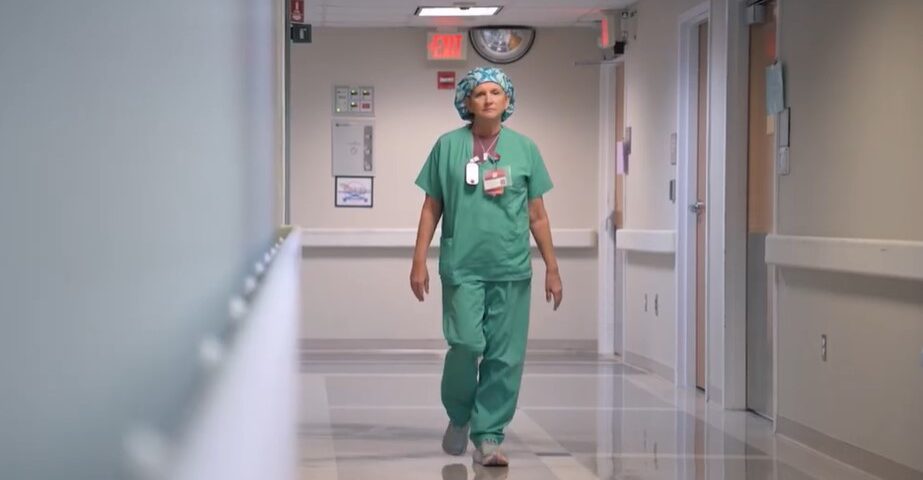
Patient stories: When a normal night at work becomes a fight to survive
It reads like the script to a television show set in a hospital: A hospital worker preparing to care for a patient having a heart attack, only to experience a sudden onset of unexplained symptoms herself and finding herself needing care from the same coworkers she’s been providing that care alongside.
For a member of Prisma Health Greenville Memorial Hospital’s Cath Lab, it wasn’t a script, but reality.
How a caregiver became a patient
Poole has been a team member with Prisma Health for 25 years, working hard within the Cath Lab, using advanced imaging technology to perform tests and other procedures on patients facing cardiovascular disease.
April 5th was a workday like any other. Poole felt perfectly fine heading into work, with no warning signs or red flags for her health.
She was scrubbing in with cardiologist Tara Holder, MD, to work on a heart attack case when she went from feeling fine to suspecting something was wrong.
Subtle early symptoms led to delay and denial
Poole felt a sudden wave of nausea and found herself breaking out in a heavy sweat, dripping down her face and the back of her neck. She felt a strange pressure beginning in and around her neck, not her chest. When Dr. Holder asked her what was wrong, she replied that she was fine and they should keep going. After all, the heart attack patient needed care, right?
“I knew something was wrong,” Poole said. “I just didn’t think it could be my heart.”
Assuming that she must be coming down with a sudden virus, Poole kept trying to power through her work, even as her symptoms persisted and began to worsen.
“I kept saying, ‘I’m fine,’ but I just wasn’t,” said Poole. “Women don’t always have those classic symptoms, and that’s what makes moments like what I experienced so dangerous.”
Carol’s teammates step in
Dr. Holder and Poole’s other colleagues noticed how badly she was struggling. Dr. Holder made a decision: She told Poole that she needed to have someone else scrub her out and take a break from caring for patients.
When Poole sat down, she checked her Apple Watch and it showed an abnormal heart rhythm. What Poole was experiencing was a bundle branch block, or a breakdown in the way the heart coordinates its beats, causing the heart to beat out of order.
The pressure around her neck began to get heavier, and colleague Jonathan Frazier, FNP, came to sit with her and check in on her.
“I kept saying I was fine,” Poole said. “I wasn’t fine.”
Tara Holder, MD, is a cardiology physician working at Prisma Health Carolina Cardiology Consultants, in Greenville, SC.
Worsening symptoms, uncertain tests and emergency care
Frazier convinced her to get hooked up to the EKG, in an experience eerily like the heart attack patient Poole had started her night caring for. Just to check for abnormal findings, he said.
Just in case.
As Poole’s symptoms continued to get worse, with increasing pressure, pain and sweating, her colleagues brought her into the Emergency Department despite her continued hesitation. There was no sign of a STEMI, or ST-segment elevation myocardial infarction, a severe type of heart attack that is caused by a complete artery blockage.
Prisma Health’s emergency care team ruled out serious complications like an aortic rupture, but as Poole’s condition deteriorated, they suspected a pulmonary edema and performed cardiac catheterization.
The very procedure that Carol Poole spent her workdays performing on others was now a procedure she was experiencing for herself.
Diagnosed with a rare heart condition and “broken heart syndrome”
Poole was diagnosed with SCAD, or spontaneous coronary artery dissection. A tear had formed in the wall of her heart artery, with blood pooling within the layers, blocking blood flow and causing her heart attack. This condition is more common in postpartum and menopausal women.
Poole was also diagnosed with stress-related cardiomyopathy, commonly called “broken heart syndrome.
Her last EKG, performed within the last year, was perfectly normal. The EKG performed in the ER showed that her heart’s ability to pump blood had been severely reduced, down to 25%.
Poole had been fortunate not only to be in a hospital environment, but to have coworkers who pushed her to receive emergency care right then and there.
Aftermath and recovery: When a caregiver becomes a patient
Poole remained in the hospital for three days recovering from her ordeal. When she was discharged, she was given a wearable “life vest,” or wearable cardioverter defibrillator, due to her reduced ejection fraction. The life vest, which she always wore except when bathing, monitored the rhythm of her heart and delivered a small shock to regulate heart function if anything dangerous was detected.
She experienced care not just from her regular colleagues within the Cath Lab, but also from staff she’d never met before across different shifts. Poole found the care from her fellow team members to be thorough, compassionate and supportive, too.
She gained a new perspective on how the patients she helped to treat each and every day were feeling physically and emotionally.
“I had all this medical knowledge and experience,” Poole said. “And yet when it happened to me, I was still overwhelmed.”
Recovery and gratitude
Follow-up care showed that Poole’s heart function had improved significantly, and she avoided the need for a permanent implantable cardioverter defibrillator, or ICD. She continues to receive ongoing treatment and follow-up care as her doctors recommend, and attributes her recovery to the fast action of her Prisma Health teammates and the expert care she received.
Her message to others?
“If something scares you, don’t try to diagnose yourself. Head to the hospital and let the professionals do that,” Poole said. “I waited longer than I should have, and I hope that you’ll take away from this that you shouldn’t wait to get that emergency care. For women especially, don’t ignore the nausea, sweating or pressure in your neck or back.”
Carol Poole had a family history of heart issues, having a father who died young from heart disease, but she’d never had any warning signs for herself and never expected to have a heart attack.
She hopes her experience will help inspire others who experience the same symptoms to act sooner.
What’s your heart age?
Take a free, fast health assessment and see if you’re at risk for heart disease.
Start Now