
How to choose the right OB for your pregnancy, labor and delivery
From the moment you see the results of that positive pregnancy test, it can feel like the list of things you absolutely have to decide right this second is endless. Do you want to know the sex of the baby before they’re born or have it be a surprise? Doula, midwife, OB/GYN… what’s the difference? What the heck is a water birth? Breastfeed, exclusive pumping or formula? Should you rely on the social media ‘birth influencer’ for knowing what to have on your birth plan? Do you want an unmedicated birth or to use an epidural? What if your doctor says a C-section would be the safest birthing option for you and your baby?
What if you don’t even have an obstetrician?
How can you know if you’ve chosen the right OB for your pregnancy?
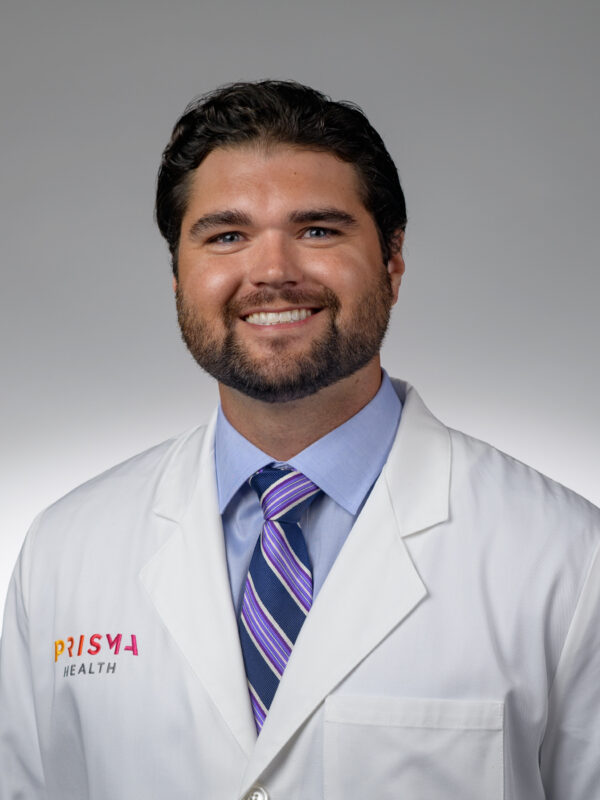
OB/GYN Matthew Scalise, Jr., MD, has dedicated his career to helping women through the complicated, natural process that is pregnancy, labor and delivery. He spoke with the Flourish podcast team on how to choose your obstetrician, including what to ask about their communication style, their philosophy of care and how their practice and the hospital you’ll deliver at handle after-hours coverage.
He also discussed red flags to watch for and why a great birth experience is one where the patient can say, “I understand and understood what was happening. I felt respected and I felt safe.”
Transcript
Cheryl Martin (Host): Bringing a baby into the world is an unforgettable time for a mother, and pregnancy comes with many birthing choices. So, being well-informed before your decisions is key. Here to discuss some of those options is Dr. Matt Scalise, an obstetrician and gynecologist with Prisma Health.
This is Flourish, a podcast from Prisma Health. I’m Cheryl Martin. Dr. Scalise, great to have you on to discuss an important topic for expectant mothers.
Dr. Matt Scalise: Thank you so much for having me, Cheryl. It’s a pleasure
Host: So before we talk about options, why don’t you share a little bit about your journey as to why you chose to be an OB-GYN?
Dr. Matt Scalise: Thank you so much. I think that’s such a crucial question. I get asked that a lot, particularly as a male provider. But I became an OB-GYN because it’s one of those few specialties where you get to be a part of some of the most important moments in a person’s life.
There is just something so special about taking care of patients through pregnancy and delivery, being there for the excitement, the anxiety, the unexpected turns and ultimately helping bring a baby safely into the world that really never gets old. But I also love that OB-GYN is not just about delivering babies. You get to care for patients across so many different stages of life, adolescence, contraception, fertility, pregnancy, postpartum, menopause, surgery and everything in between. And that mix of relationships and procedures, where one day you’re counseling someone through a really personal decision, and the next you’re delivering a baby, and then managing an emergency and then doing surgery. It’s just an emotional, technical, unpredictable and very human specialty that was so amazing.
Host: Well, I can tell that you are passionate about your job and that you love it, that it’s a calling. So, what does a woman need to keep in mind when choosing an obstetrician?
Dr. Matt Scalise: Yeah. Before we jump in, I just should probably acknowledge the obvious, and of course, I am a man, so my personal labor experience is extremely limited, and by which I mean it’s completely nonexistent. I’ve never had a contraction. I’ve never felt a baby kick in my belly, and I’ve never had someone tell me to just breathe while I was actively questioning all of my life decisions.
But that absolutely shapes my perspective. You know, what I can offer is the perspective of an OB who has cared for lots of patients through labor and delivery. I’m really happy to chat about the different nuances of obstetric care. And I always want one thing to be clear: Birth is not something that providers should control. It’s something we should help support, guide and make as safe as possible.
And so, getting into your question about what women need to keep in mind when choosing an OB provider, think of the OB provider as like choosing your birth team captain. You want someone who makes you feel heard, safe, informed, but also someone that’s going to help push you to do something you didn’t think your body was going to be able to do. You want to have a cheerleader, but you also want to have someone that’s going to be open and honest with you.
And there’s three additional things I really want people to consider, and I wrote this down. And the first, communication style matters. So, you need to feel comfortable asking questions like, “why are we doing this?” Or “what are my options?” Pregnancy comes with a lot of different decisions, and you want a provider who can explain things clearly without making you feel silly or dumb for asking them.
And number two, ask about your provider’s philosophy of care. Some patients want a very low intervention experience, while others want an epidural as soon as they hit the parking lot. Now, none of those things are bad or anything in between is wrong, but the key is finding a provider that supports your goals but is also honest if medical circumstances would change.
Now, the third thing is thinking about the whole system and not just one person. And what I mean by that is that the reality of modern OB practice is that it’s shifted from smaller private practice groups to a larger group model. So as a result, you often are considered a patient of the practice rather than a specific physician. And so, a good question to ask may be, you know, who covers after hours or on the weekends, or who delivers you if your provider is not on call? What hospital do they deliver at? What resources are available in terms of anesthesia, nursery versus NICU, blood bank even?
Now, I don’t think patients need to be necessarily asking about the minutiae of pregnancy care at that stage, but having a basic understanding of how the practice works and what capabilities the hospital has is very important. The bottom line is choosing someone who respects your birth preferences, but also needs to be prepared for birth realities.
Host: What I love is you don’t mind the questions, you actually welcome them.
Dr. Matt Scalise: Absolutely. I think any time your provider is giving you any flak for asking questions or taking ownership of your personal health, that’s certainly a red flag.
Host: So, what is a birth plan? And what should you consider when creating a birth plan?
Dr. Matt Scalise: A birth plan is basically a written guide to your preferences for labor, delivery and the immediate postpartum period. But I like to think of this more of like a birth wish list because birth is not always something we can fully plan. Babies are wonderful, but man, they are terrible at reading the itinerary.
So, a good birth plan should cover stuff like labor preferences, number one. And that means, in terms of movement, position changes, what kind of music or lighting do you want, who is in the room or not in the room, in-laws included, whether you want a doula, IV preferences, monitoring preferences.
The next thing would be pain management. So, you know, kind of mentioned briefly, unmedicated labor versus using adjunctive pain medications such as nitrous oxide versus epidural or just saying, “Listen, I’ll decide when I get there.” Another thing to put in your birth plan is delivery preference, meaning, “What kind of pushing positions do I want? Do I want a mirror, delayed cord clamping, skin-to-skin? Who cuts the cord?”
And lastly, newborn preferences. Breastfeeding versus formula, really capitalizing on that golden hour. Newborn medications and vaccinations they prefer, and then talking about circumcisions if it’s applicable.
But the most important thing is to keep that birth plan, that birth wish list, flexible. A birth plan should never feel like a contract with your medical team, in my opinion. It’s more of a conversation starter. I feel like there’s so much stuff out there on social media that’s definitely added to the colorful flavor of many birth plans. Sometimes, while some things on social media are rooted in truth, it may not be as clinically applicable to that particular patient.
Patients sometimes there can be an adversarial dialogue that happens between the provider and the patient if what they’ve heard maybe doesn’t coincide with that provider’s recommendation. So again, having that open and honest discussion is so important so that we can come together to find a good birth plan that fits within what you want to do, how you envision that birth, but also it’s safe.
My ultimate goal is a healthy mom and a healthy baby. And as long as we can agree on that, I think we’re in good shape.
Host: That’s great. Now, you know there are a lot of options these days. So, one question is, why should you choose a hospital for your baby’s birth versus a birthing center or home birth?
Dr. Matt Scalise: People sometimes think choosing a hospital means giving up a calm or natural birth experience. Now, that’s honestly the furthest thing from the truth. A hospital can still support a very personal, low intervention birth, and especially at Parkridge where I work at.
But it also, most importantly, gives you immediate access to emergency resources if it’s necessary. The biggest advantage of a hospital is that if things change quickly, help is right there. Labor can be a beautifully normal, labor course hours and hours, but then suddenly require immediate intervention for bleeding, fetal heart rate concerns or shoulder dystocia, severe blood pressure issues, infection, so on and so forth.
I recently had a patient with a very uncomplicated term delivery, but their baby had trouble breathing as soon as baby came out with delivery. And we suspect this is due to some type of something called a meconium aspiration. And meconium is baby poop, and sometimes babies, when they’re in some distress in the womb, they poop and that’s called meconium. And if they aspirate that, they breathe that into their lungs, it can cause a lot of irritation and makes it harder for those babies to move oxygen more easily, which can be really concerning when you’re trying to comfort baby. Baby’s not breathing as well as we want, still a little blue perhaps. And in that particular circumstance, we’re able to really quickly and seamlessly identify that being an issue. We’re able to transfer that baby to our nursery to get some additional respiratory support, and that baby was back in the room with mom just a few hours later.
What I lose sleep over is thinking about those moms out there with home births having something like this, despite being uncomplicated and low risk, but not having that right staff or that training or equipment to intervene when something happens.
So, I say all this not to scare patients. I really think that scare tactics have been used way too often to over-medicalize pregnancy. But it’s also true that a planned home birth is associated with a higher risk of perinatal death, neonatal seizures, and comparatively speaking to hospital births, even though that overall risk is very, very low.
Now, it’s also important to know that certain things like fetal malpresentation, you know, like a breech presentation or, basically, if baby’s not head down, if you’ve got multiple pregnancies, twin, triplets, et cetera or a prior C-section, those would be definite contraindications to a planned home birth.
Now, that doesn’t mean that every patient needs to have a highly medicalized birth. It means that the safest place to have, again, a “natural birth” is often a place where the medical backup is immediately available.
The hospital is not there to take over your birth. It’s there to be ready if birth decides to take a turn.
Host: I’m glad you mentioned natural childbirth. So, how can you have a natural childbirth in a hospital?
Dr. Matt Scalise: You can absolutely have a natural childbirth in a hospital. Hospital birth does not automatically mean epidural, Pitocin, lying flat on your back and bright lights with med students and strangers looking at very intimate parts. For many low-risk patients, hospitals like Parkridge, where I work at, support movements during labor, wireless monitoring or intermittent monitoring when it’s appropriate.
We’ve got birthing balls, peanut balls, squatting bars. There’s hydrotherapy and showers. We’ve got doulas and support folks, low lighting, music, aromatherapy, delayed cord clamping, all sorts of things that would historically be associated with, again, quote unquote, “natural childbirth.”
But the key here is just communication. We want you to tell your team, “I’m hoping for an unmedicated birth. I’d like support with movement, positioning. I want coping techniques.” That lets your nurses, your provider and your support team help protect that goal.
Just to be clear, getting an epidural does not mean you failed. Needing Pitocin at any point in labor does not mean that you failed and your body can’t do it. And even having a C-section doesn’t mean that there’s something wrong. The goal is not to win a toughness contest. You don’t get a special certificate if you’ve had an unmedicated birth. The goal is to feel informed, respected and safe.
Host: What is midwifery care and when is that a good option?
Dr. Matt Scalise: Midwives or midwifery care, these folks are just experts in normal low-risk pregnancy and birth. Now, their care model often emphasizes education, prevention, emotional support, physiologic labor, kind of helping patients avoid unnecessary intervention when it’s safe to do so. Now, OB-GYN physicians, obstetricians, gynecologists, they’re trained in both normal and high-risk pregnancies. And I would say they’re also surgeons. So, that means that they manage complications that can arise in pregnancy, such as severe hypertension/preeclampsia, heavy bleeding and abnormal kind of heart tracings requiring either operative vaginal deliveries or C-sections. So, I don’t like framing it as like, you know, midwives versus doctors.
The best systems, which is what we have and what I’m really proud of at Parkridge, is that it’s a very collaborative approach. Midwives are excellent at supporting normal labor, and our OBs are there for higher risk situations or when birth needs medical or surgical intervention. And a kind of simple way to say it is that midwives specialize in supporting normal birth, while OB-GYNs are trained to manage both normal birth and complications, and especially when surgery or higher level of medical care is needed. So that’s kind of my philosophy
Host: And what is a water birth and when is that a good choice?
Dr. Matt Scalise: A water birth usually refers to laboring and sometimes delivering in a tub of warm water. It’s very popular because warm water can help with relaxation, pain control, mobility and that feeling of being kind of less on display during labor. But it’s an important distinction between laboring in water and delivering underwater, which those are not really the exact same thing.
So, for appropriate low-risk patients, water immersion during the first stage of labor up until about six centimeters can be a really helpful comfort tool. Delivery underwater is more controversial and depends heavily on particular hospital policies. And so, definitely inquire about water birth options depending on where you wanted to deliver.
But also, provider comfort factors into that, patient risk factors, and just having emergency readiness on hand is also important. So, some hospitals allow laboring in water but ask patients to get out of the tub for delivery, while others have more formal water birth programs with specific criteria.
So, water labor may be a good option for someone who is full-term, low risk, they’ve got a reassuring fetal status, there’s no infection concerns, there’s no need for continuous interventions and then, importantly, a facility and staff that’s trained and clearly follows some safety protocols. Water can be a great tool in labor, but like every tool in birth, it works best when we use it for the right patient and in the right setting and with the right safety plan.
Host: Anything else you’d like to mention about birthing options?
Dr. Matt Scalise: When we talk about birthing options, the goal here should not be to make one type of birth sound superior to another. The goal is to help patients understand their options and choose a setting and team that really match their values while keeping safety at the center. A great birth experience is not defined by whether it was unmedicated or medicated, vaginal versus cesarean, midwife or physician-led. A great birth experience is one where the patient can say, “I understand and understood what was happening. I felt respected, I felt safe, and my team was prepared.”
Host: Dr. Matt Scalise, thank you for your time and sharing your expertise on birthing options. A birth team captain and cheerleader. Some great advice. Thank you.
Dr. Matt Scalise: Thanks, Cheryl. It was a pleasure
Host: For more information, visit prismahealth.org/podcast. Now, if you found this podcast helpful, please share it on your social media and check out our podcast library for other topics of interest to you. This is Flourish, a podcast from Prisma Health. Thanks for listening.
Read MoreFind an OB/GYN provider who’s right for you
When you’re ready to grow your family, choosing the right provider is important. Learn more about our obstetricians, midwives and nurse practitioners.
Find a Provider